在信中,法援詳列戶戶送對外賣員的控制、工作設備、承擔財政風險等三方面分析,例如戶戶送的外賣有權何時登進或登入戶戶送的Apps、選擇接單、工作地點,其中又指出「戶戶送是無法控制或監督外賣員送貨工作程序和方法,你是用Google地圖引路的。(Deliveroo had no control or supervision over the procedure and method you carried out your delivery job. You used Google map to direct your route.)」
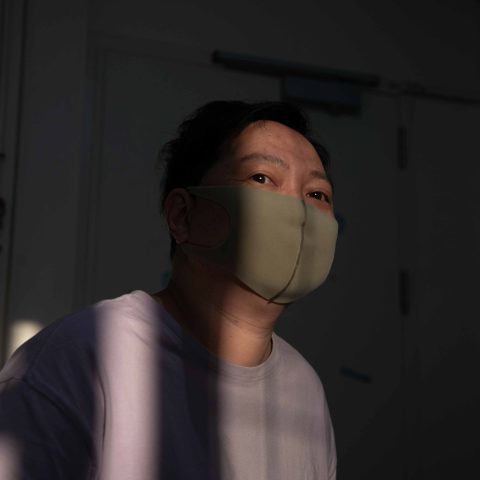
Gurung稱無力支付訴訟費,感到前路茫茫。(陳嘯軒攝)
Gurung以尼泊爾語透過英語傳譯對《誌 HK Feature》表示失望:「律師行說會替我收集所需文件,繼續法律程序,但後來又改口說如果我是『自僱』,就不能夠再打官司。」申請法律援助被拒後,律師行不再為他代理案件。對法律一竅不通的Gurung未清楚敗訴的風險,2024年8月19日在無律師代表下出席區域法院的聆訊。區域法院暫委法官汪祖耀只進行一天聆訊,11月15日頒下判決,裁定訴訟雙方沒有僱傭關係,而且申請人已從公司為非僱員購買的保單獲益後仍然額外索賠屬「濫用程序」,下令剔除Gurung的僱員補償申索,並要向戶戶送支付訴訟費。
Court and Legal Aid rule no employment relationship, lawyer says future cases remain arguable
Journalist / Chan Siu Hin Editor : Kwan Chun Hoi
Gurung, a Nepali food delivery rider for Deliveroo, has drawn public attention after he sustained serious injuries in a traffic accident while on duty. The accident left him unable to work for nearly 16 months. Gurung sought compensation from Deliveroo, filing a claim under Hong Kong’s Employees’ Ordinance.
However, a legal grey area persists over whether gig economy workers qualify as “employees” under the Ordinance, directly impacting their eligibility for work injury claims.
Despite a previous Labour Tribunal ruling that recognized an employment relationship between Zeek’s delivery riders and the logistics company, Gurung’s case was dismissed by the District Court without trial. He now faces a claim for HK$280,000 in legal costs from Deliveroo.
Legal aid rejected with detailed reasons
Gurung, 48, a food delivery rider from Nepal, began working with Deliveroo in 2021 under a “Supplier Agreement” that labelled him self-employed. On 26 February 2022, while rushing to deliver an order in Sheung Wan, Gurung’s motorbike collided with a vehicle. The impact sent him skidding across the road before a taxi struck him. He sustained a fractured right clavicle and lasting injuries to his right hand. Two fingers remain bent and unrecovered to this day.
Gurung was on medical leave for over 15 months. Deliveroo’s voluntary insurance policy provided him with a payout of HK$100,000, but it was far from sufficient to cover his long-term needs. In 2023, with encouragement from a friend, Gurung turned to a law firm and filed a claim under the Employees’ Compensation Ordinance, hoping to be recognised as an “employee” and receive formal compensation for his injuries.
However, his journey toward justice soon unravelled. His legal aid application was rejected in mid-2024. In the rejection letter, the Legal Aid Department cited his “self-employed” status and listed Deliveroo’s limited control over delivery workers, pointing to the flexible login hours, freedom to accept or reject orders, and independent route planning using Google Maps. Shortly after the rejection, the law firm also withdrew from his case.
Left alone and unfamiliar with legal procedures, Gurung stood before the District Court unrepresented on 19 August 2024. “I thought they would help me gather documents and move forward,” he said in Nepali, “But when legal aid was denied, everything stopped.”
On 15 November 2024, Deputy District Judge Joseph Vaughan ruled against Gurung after a one-day hearing. The court found that Deliveroo did not have an employer-employee relationship with him and dismissed the case as an “abuse of process” since Gurung had already received the company’s voluntary insurance payout. The judgment also ordered Gurung to pay Deliveroo’s legal costs—estimated at HK$280,000.
The court based its decision on criteria established in previous labour rulings, examining factors such as control over work, use of personal equipment, and financial risk. While Deliveroo’s app tracked rider activity and allowed it to terminate workers for repeated complaints, the court deemed this to be minimal control, typical of independent contractor arrangements.
“60-second rule” The critical evidence in court
Gurung contested Deliveroo’s portrayal of riders’ “freedom to reject orders,” telling the court that rejecting orders would cost him to lose “boost fee” and that riders were pressured to accept jobs quickly. He described a practice of having to accept the order within 60 seconds or risk warnings. The defendant denied any formal “60‑second rule,” saying instead that riders who accept over 80% of orders may qualify for a 1.3× bonus. The judge found no documentary proof of a 60‑second requirement and concluded Gurung was not obliged to meet the high performance threshold needed for the boost.
The court also underlined structural features that, in its view, point to independent contracting: Gurung supplied his own motorbike and phone, bought his own uniform and thermal bag, and bore traffic and fine costs. The judge dismissed the argument that the mobile app constituted significant “equipment,” noting that downloading and logging in carried negligible cost. These findings echoed the Legal Aid Department’s earlier analysis when it refused Gurung assistance.
For Gurung, the ruling had severe human consequences. Before the crash he said he worked full‑time for Deliveroo — about 30 orders a day, earning HK$1,500–1,800 daily. Now recovered but unable to return as a rider, he and his wife survive on guard jobs paying HK$800 a day while supporting relatives in Nepal. Shocked by the “self‑employed” label, Gurung asked, “I don’t even have a business registration, how am I self‑employed?” He declined to appeal, fearing further loss, and now faces a demand from Deliveroo to pay HK$280,000 in legal costs, with the company warning of further action if he does not pay.
Facing claims for Deliveroo’s legal fees
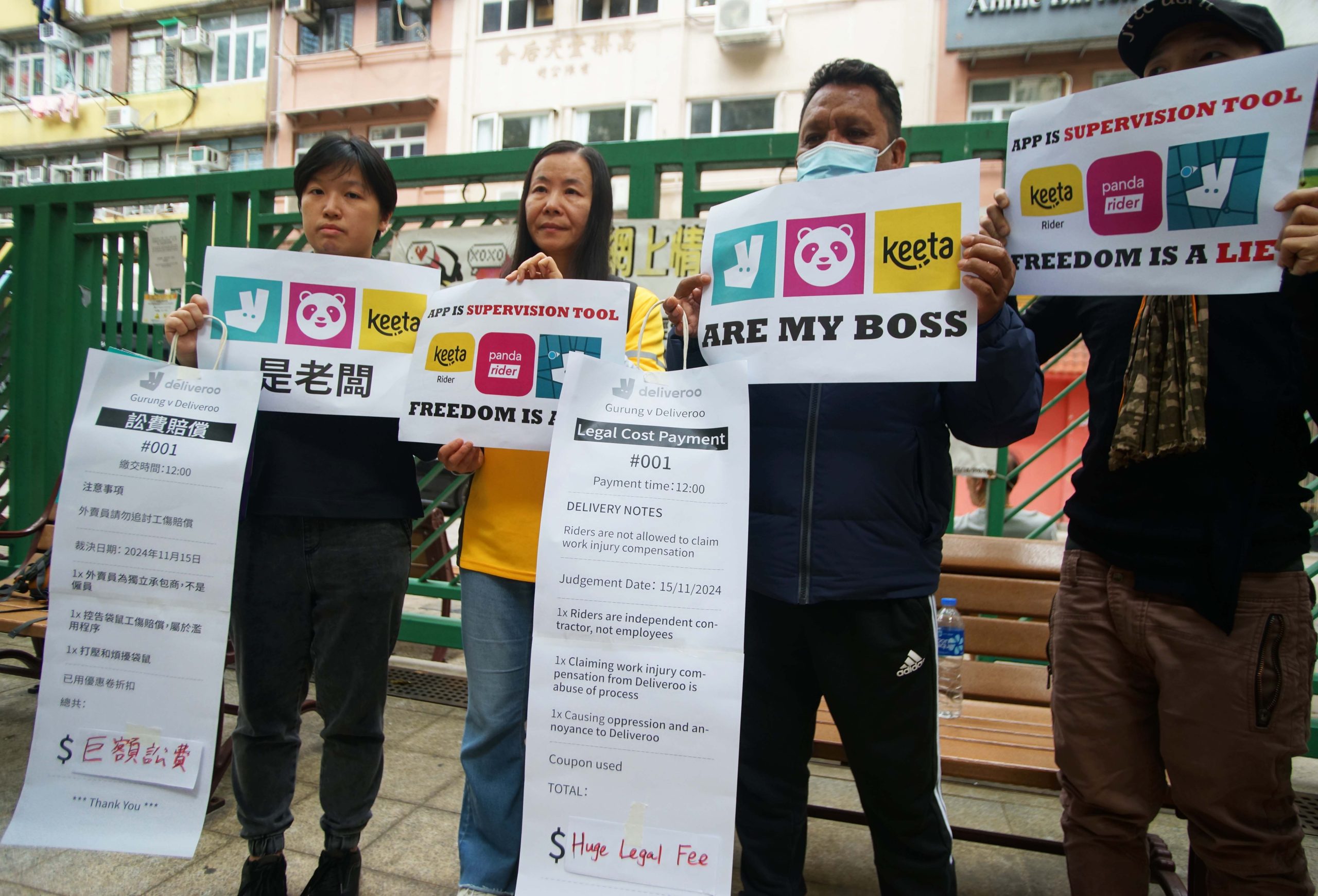
A riders’ advocacy group, the Riders’ Rights Concern Group, has expressed disappointment after the court’s ruling in Gurung’s case and urged the platform to drop its demands for legal costs. “Gurung worked up to 12 hours a day for Deliveroo and was on duty when he had his accident,” said Justine Lam, a member of the group. “Deliveroo must not pursue costs from an injured rider.” Lam argued that if Gurung’s claim had been resolved under the Employees’ Compensation Ordinance correctly, he might have been entitled to at least HK$500,000 in compensation. “The real issue is that Deliveroo is not providing fair compensation to injured riders,” she said.
Lam added that the court’s decision failed to keep pace with the digital era and overlooked how app‑based platforms exert control over riders. “Not only do riders have to report through the app whenever there is an issue, the app also tracks their performance, including delivery speed, etc.,” she said. This structure, she contended, places delivery workers under constant pressure to rush, increasing the risk of accidents.
Another rider, Mr. Wong, demonstrated his app to HK Feature and noted that unless he tapped “Accept” within 60 seconds of receiving a task, the screen would immediately display “Order no longer available”. “I deliver on a bicycle. Sometimes I’m worried because I have to watch the app on the road while riding. I’m trying to keep my acceptance rate above 80%. It makes me very nervous,” Wong said.
In May 2023, the Labour Tribunal determined that delivery workers at Zeek—an online logistics platform that has since ceased operations—were employees despite having signed “self-employment contracts.” The tribunal’s ruling, grounded in the same 11 legal criteria later cited in the Gurung judgment, affirmed that these workers qualified for the Protection of Wages on Insolvency Fund.
Commenting on the decision, lawyer Michael Szeto told HK Feature that courts consider a range of operational factors beyond contractual labels when evaluating employment relationships. “The judge in the Zeek case formed the view that the company exercised significant control over its couriers, unlike Deliveroo, where riders appeared more akin to self-employed contractors,” Szeto explained.
Another Deliveroo rider, Ah Chun, sustained a serious brain injury in December 2022 after crashing into a lamp post while delivering food in Tuen Mun. His application for legal aid to pursue an employees’ compensation claim was rejected, with the Legal Aid Department concluding he did not qualify as an “employee.” Nevertheless, in December 2024, just before the statutory two-year deadline, Ah Chun proceeded to file a claim, with the legal outcome still pending as his aid appeal is under review.
Lawyer: Riders’ claims are still arguable in future cases
In the wake of the recent District Court ruling dismissing food delivery rider Gurung’s injury compensation claim as “plainly and obviously unarguable,” questions have resurfaced over the precarious legal status of gig workers in Hong Kong. While the judgment dealt a blow to Gurung’s case, legal experts say it does not rule out the possibility of success in similar future claims.
Barrister Michael Szeto told HK Feature that although the Gurung case may serve as a reference point, it is not legally binding. “Every case is different. Whether the court finds there is an employment relationship depends on the claimant’s evidence and how the alleged employer exercises control,” he said. Szeto emphasized that even the concept of ‘control’ is evolving, and courts must adapt their interpretations to reflect the modern gig economy.
“The legal framework for employment was built around the traditional ‘master-servant’ model,” Szeto explained. “But that logic doesn’t fit today’s gig workers, who work for multiple platforms and juggle different jobs. If we keep relying on outdated frameworks, gig workers will never be recognized as employees—even when they clearly depend on platforms for income and instructions.”
In Hong Kong, only workers recognized as “employees” are protected under the Employment Ordinance. This legal classification determines access to rights such as minimum wage, injury compensation, and benefits like paid holidays and severance pay. Gig workers often fall outside this scope, with their employment status left uncertain until tested in court.
Szeto pointed to Singapore as a potential model. With a similar common law system, Singapore has begun exploring dedicated legislation to define gig workers’ status and rights. “What we need is a third category in law, something between ‘employee’ and ‘self-employed,’” he said. “If protections are clearly outlined from the start, gig workers won’t need to go to court every time something happens. This would not only safeguard vulnerable workers but also reduce legal uncertainty and delays.”